
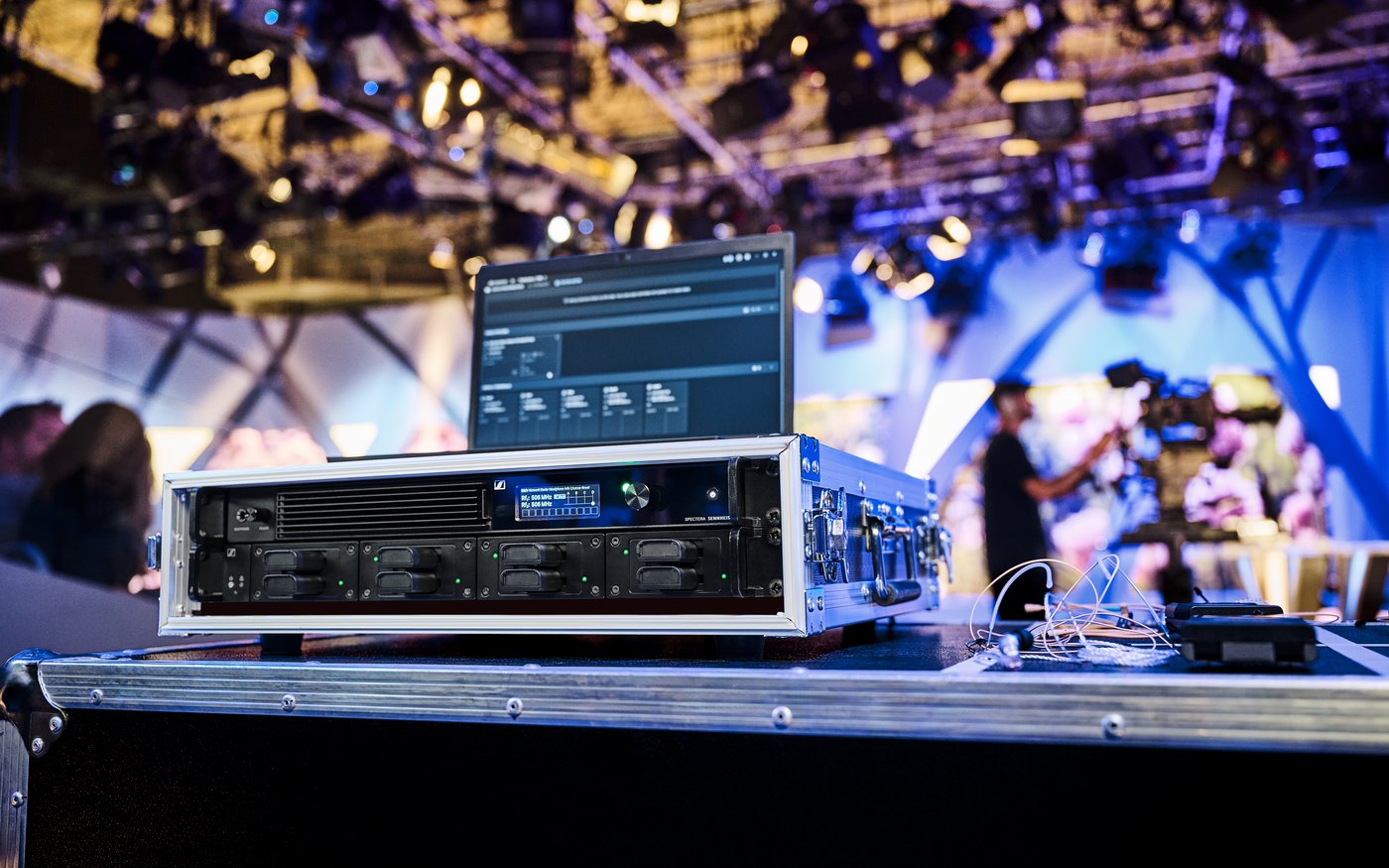
Spectera is Sennheiser’s wideband, bidirectional digital wireless ecosystem — the first built on WMAS. Instead of coordinating dozens of narrowband frequencies, an entire production runs inside a single 6 or 8 MHz carrier, with microphones and in-ear monitoring sharing the same bodypack and the same 1U base station.
What WMAS changes
Conventional wireless gives every transmitter its own narrow slice of spectrum, and every slice has to be coordinated against every other one and against local broadcast. WMAS — Wireless Multichannel Audio System — inverts that. One wide carrier, 6 or 8 MHz, carries the whole production. There is no per-channel frequency plan to build, check on site, and rebuild when something changes.
Because the carrier is wide, the system can spread each link across it. Sennheiser rates the result as the equivalent of 40x diversity on an 8 MHz carrier and 30x on 6 MHz, which is what makes Spectera markedly more resistant to the multipath fading that causes dropouts on narrowband systems.
Bidirectional: mic and IEM in one pack
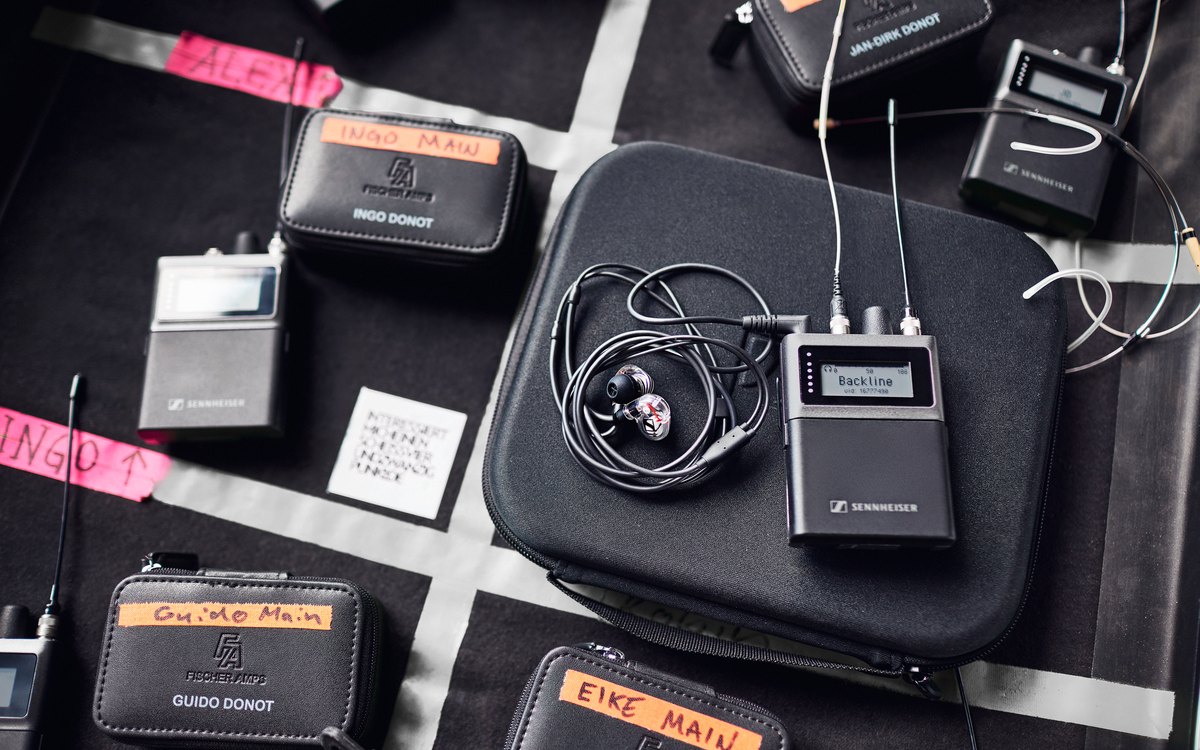
The link runs both ways. The Spectera SEK bodypack is simultaneously a mic/line transmitter and an in-ear receiver, so a performer carries one pack instead of two. It also means the base station can see and control what is happening at the pack — IEM volume, audio level, RF health and battery status are all visible and adjustable from the rack.
A handheld, the Spectera SKM, joins the family, and both the SEK and SKM are available in UHF and 1G4 versions.
The system
- Spectera Base Station — 1 RU, up to 64 channels (32 in / 32 out), two independent wideband carriers, redundant power supplies, redundant Dante and optional redundant MADI.
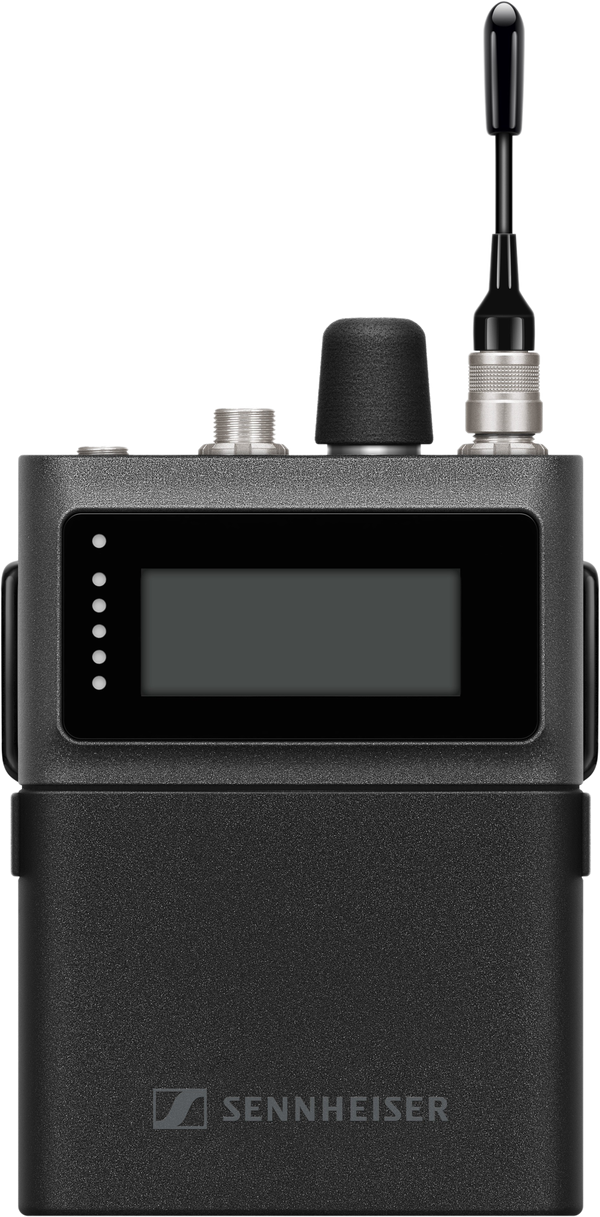
- Spectera SEK — bidirectional bodypack handling mic/line and IEM at once.
- Spectera SKM — handheld transmitter.
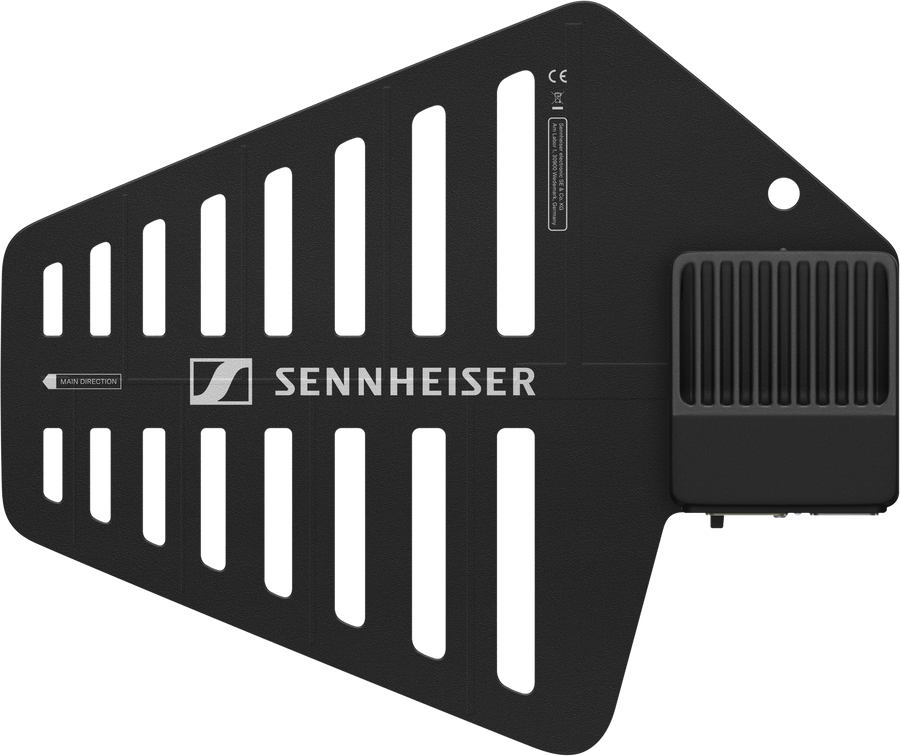
- Spectera DAD — transceiving distributed antenna with the RF distribution built in, so no separate combiners or splitters. Up to four units for coverage and redundancy.
- Software — the Spectera WebUI for a single system, SoundBase for multiple systems, and Sennheiser LinkDesk.

Frequency, audio and latency
Spectera operates in UHF (470–663 MHz) and in the largely uncongested 1G4 band (1.435–1.525 GHz). Audio is uncompressed, up to 24-bit / 96 kHz. Latency goes down to 0.7 ms for IEM and IFB and 1 ms for mic and line signals, and eleven Audio Link modes let you trade latency, bandwidth and channel count to suit the job.
Control
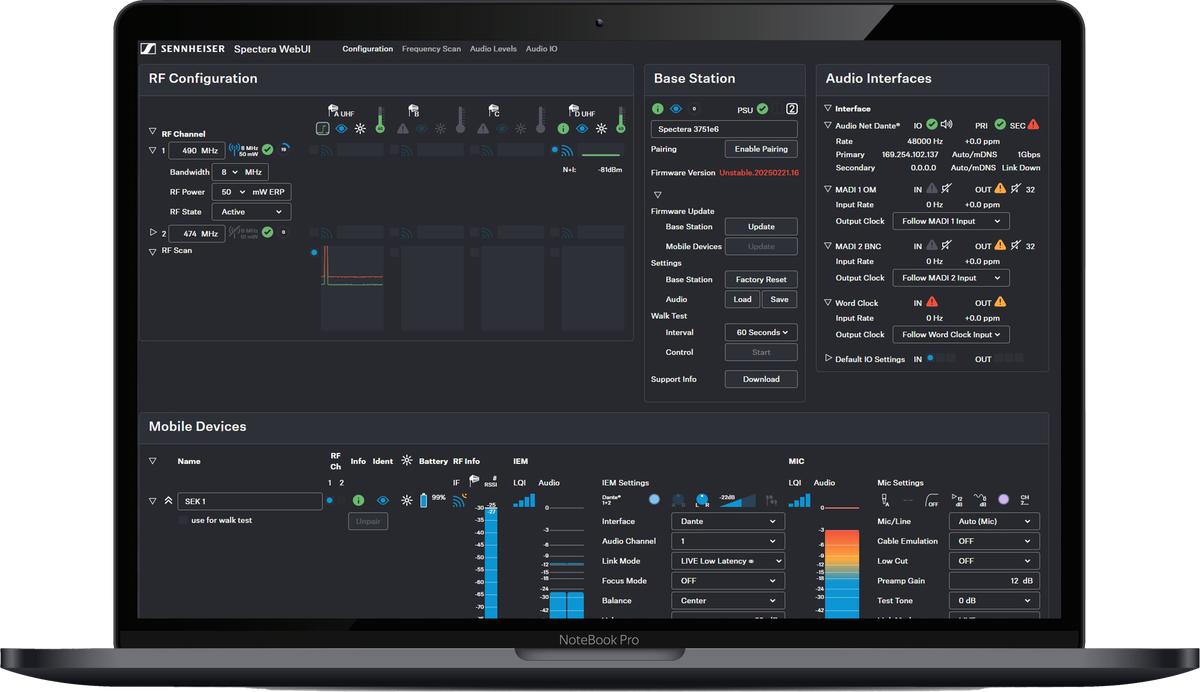
Everything is managed from one place. The WebUI covers a single base station; SoundBase handles planning and monitoring across multiple systems, including Spectera mode planning.
Where it fits
Spectera suits productions where channel count, coordination time and dropout risk are the constraints: touring and festivals, broadcast galleries and studios, theatre, and large venues where RF is congested and the schedule is unforgiving.

AMSYS supplies and integrates the full Spectera range as a Sennheiser partner. Talk to us about channel counts, antenna design and how Spectera fits alongside the systems you already run.